

home about us archaeology excursions sea offers territory contact link gallery
|
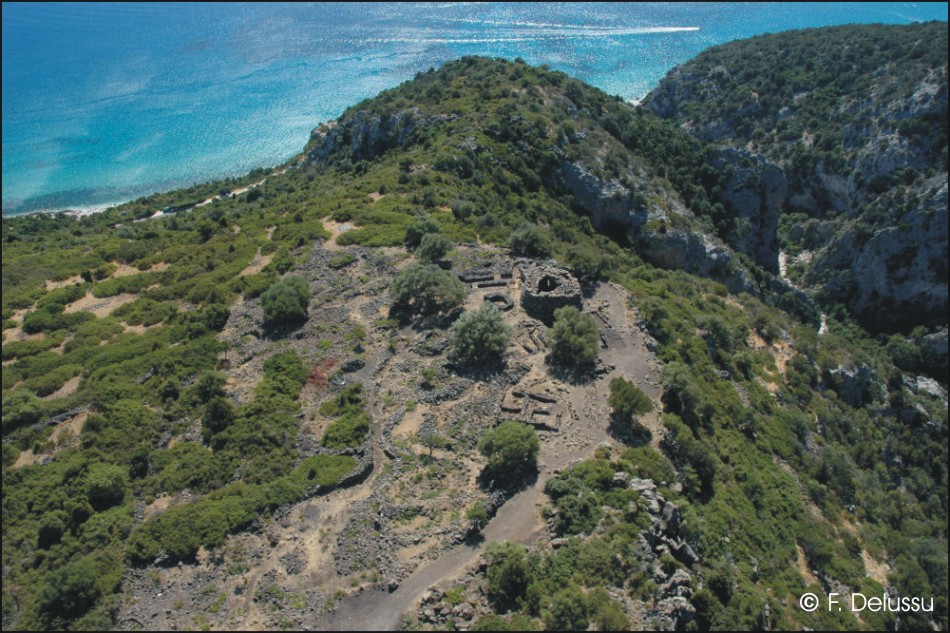
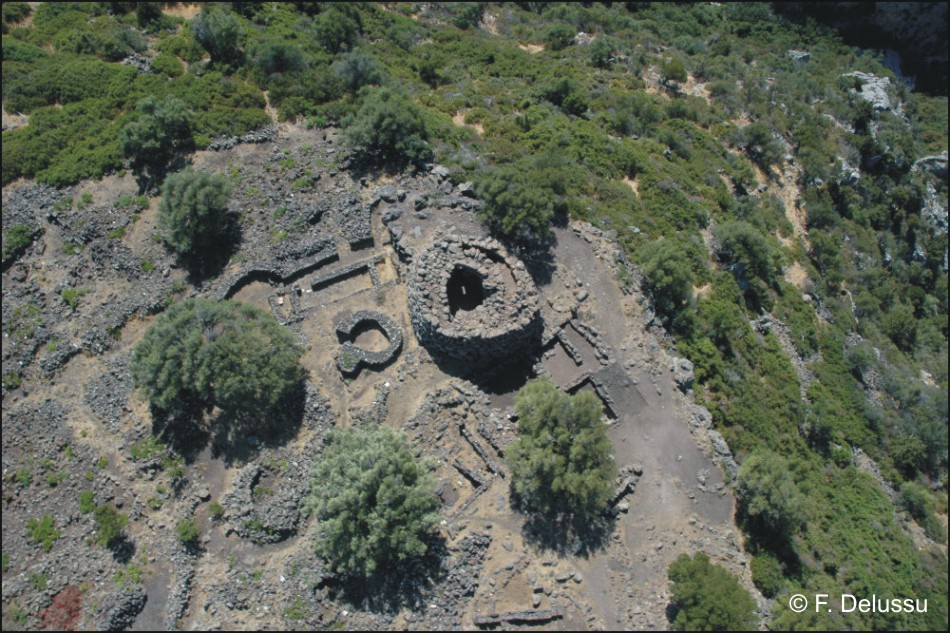
The first archaeological reports related to Nuraghe Mannu came from Antonio Taramelli in 1927 when he explored this site. The area is rich in a large quantity of perfectly worked square basalt stones and it is dominated by the nuraghe itself. Despite the name ("mannu" means large in Sardinian), it is a single tower of restricted dimensions, built with large basalt blocks laid in irregular rows. It stands beside the canyon called Codula di Fuili, and could have been used as an important sighting point, looking out to sea and communicating with other towers across the whole Gulf of Orosei. The east facing entrance is topped by an irregular lintel and two rows of blocks. Above this lies a little window-hole for taking items in and out. A corridor covered by flat rocks leads to an elliptical room that still has two large raised niches. In the passage there is a winding staircase that once led to the terrace. Around the nuraghe there is a vast village site occupying several hectares. This is mostly covered by collapsed walls, scrub and thickets of mastic, with roots deeply buried amongst the buildings’ foundations. In 1933, in giving an account of his sightings in the Dorgali region, Taramelli highlighted the presence of certain blocks of stone among the structures built during Roman times. According to this scholar, these Roman dwellings were constructed with elements from ancient Proto-Sardinian buildings which had been used for religious ceremonies near the inhabited area. The finding of some blocks of basalt engraved with geometric shapes gave further proof to the archaeologist of the presence of an original ceremonial cult building, which could be compared with the decorative and building techniques he found in other places in Sardinia he had previously excavated, such as Sardara, Serri, Bonorva and Nuragus. The rectangular and square buildings explored by Taramelli were thought to be for military use, from which soldiers were able to check the coastline for possible landings of enemies wanting to bring provisions and weapons to the people inland who were involved in a guerrilla war opposing the Roman conquest. To reach a clearer understanding, the area was excavated and various ceramic and stone materials and tools were found which proved the area was inhabited at differing times. Since 1994, Nuraghe Mannu has been the site of eight excavations by hundreds of volunteers supervised by experts from the Archaeological Superintendence bureau. The surveys and digs in the village and in the nuraghe have revealed that the first building phase of the village took place in the Middle Bronze Age around 1500 BC. The time of the greatest habitation, based on the quantity of recovered materials, was in the Recent and Final Bronze Age around 1200-1000 BC. Among the ceramic materials that enable us to discern precise cultural periods, objects and tools of daily use were recovered, such as stoves, river pebbles used as pestles and burnishers, and different kinds of millstones that bear witness to intense cultivation of various grain crops. Close to excavations where nuragic material was found, a Roman building was explored. This had been built above the remains of pre-existing nuragic dwellings, and a dressed standing stone (stele) of trapezoidal form with three holes on the shortest side was found here. This type of stone with notches (dentelli) is found at "giants' tombs", a type of ceremonial gravesite with a “stele centinata" – a high upright stone slab with a rounded top - placed at the centre of a semicircular ceremonial area (esedra) made of other upright stone slabs in front of the tomb to create an external cult area. In the building were found fragments of roof tiles belonging to the original roof, fragments of cafeteria vases and kitchen tools dating from the 4th century BC, fragments of glass, amber, and bronze nails. Among the ceramic materials were large pieces of amphoras (pithoi), used as containers for food, wine, oil, etc. The excavations clearly show the remains of a real urban centre. Its history must be further explored in more buildings around the nuraghe, including the most ancient underlying nuragic layers, to give a fuller understanding of phases of abandonment and re-use, and indeed what caused these changes.
|
|
Month |
Opening times: morning |
Opening times: afternoon |
| Genuary/February/March | on request (minimum 10 people) | |
|
April |
10:00 - 13:00 |
15:00 - 18:00 |
|
May |
09:00 - 12:00 |
16:00 - 19:00 |
|
June |
09:00 - 12:00 |
16:00 - 19:00 |
|
July |
09:00 - 12:00 |
16:00 - 19:00 |
|
August |
09:00 - 12:00 |
16:00 - 19:00 |
|
September |
09:00 - 12:00 |
16:00 - 19:00 |
|
October |
10:00 - 13:00 |
15:00 - 18:00 |
|
November/December |
on request (minimum 10 people) |
|
Ticket: Full price 4.00 euro, Reduced price 2.00 euro (children and +70). |