home about us archaeology excursions sea offers territory contact link gallery
 |
|
 |
Serra Orrios
|
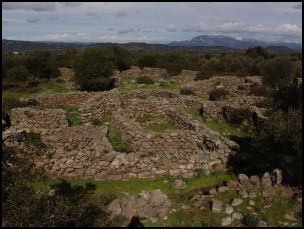
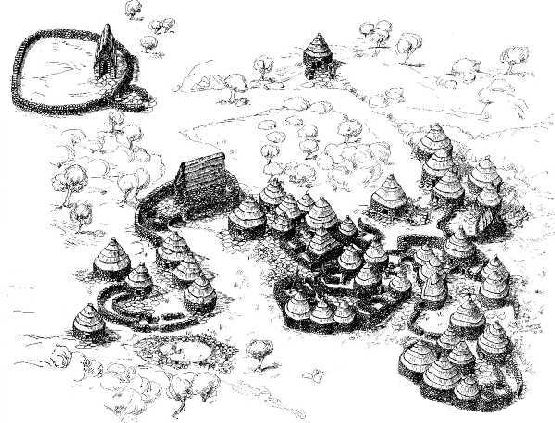
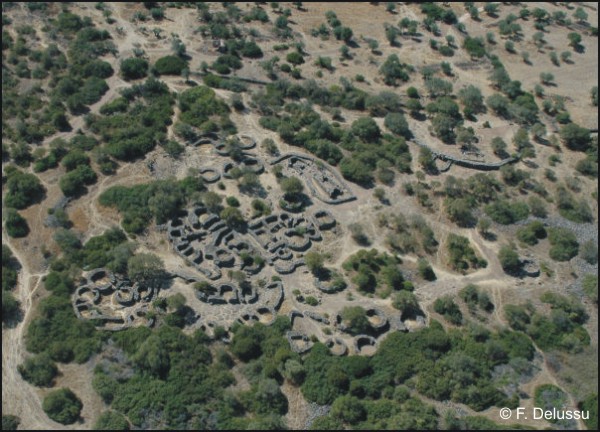
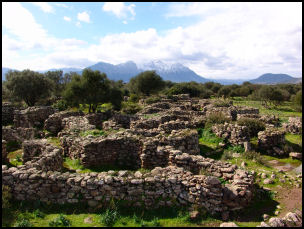
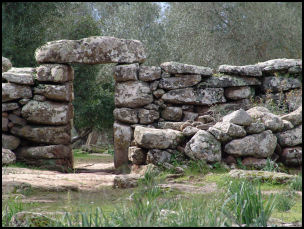
The Nuragic village of Serra Orrios is in farmland near Dorgali on the lava plateau of Gollei. Archaeological exploration started here in 1936 and the following restoration brought to light a settlement of about a hundred huts built of local basalt stones without mortar and irregularly arranged to create circular rooms. The site’s layout is remarkable because of the presence of two rectangular “megaron” temples with enclosures. There are several huts in a free-form layout and three groups of huts that group circular rooms around shared courtyards, where there are remains of wells and cisterns. These blocks or “insulae” are documented in other nuragic villages and have been interpreted as showing a phase of architectural evolution where the layout of wall structures changed to be more advanced than other groups of isolated huts with their less functional form.
Many ceramic pieces from this site are dated between the final phase of the Ancient Bronze Age and the Middle Bronze Age (1600 BC – 1400 BC), such as pots of the Bonnànaro tradition (taking this name from the town where this kind of pottery was found for the first time in a tomb) and terracotta pans imprinted with decorations made with combs. The time of the most intense habitation was revealed by materials from the New and Final Bronze Age, with a large number of rounded vases with cylindrical collars and handles that look like overturned elbows, other thick-rimmed and semicircular vessels, and askoid jugs decorated with grooves and geometrical patterns that look like herring bones and dice points. A special place among the ancient manufactured items goes to the tools for production of textiles, such as spindles, weights for looms, and spools. A particular sense of decoration was shown in the pintaderas (terracotta stamps used to decorate bread and textiles). Among the objects of everyday life found here were terracotta stoves, ladles, elegant polishing stones, pestles, millstones and a matrix for melted bronze, which all show an intense area of production. But the most attractive architectural elements are certainly the two “megaron” temples, which could be regarded as resulting from cultural exchanges in the light of recent discoveries concerning the presence of the Myceneans in Sardinia, confirmed nearby on the east coast where fragments of Mycenean goods have been found.
|